Tuesday, June 10, 2014

1990-1999 Mclaren F1


Origin: Cars made by McLaren Automotive have only one purpose: of incorporating as much Formula 1 technology into a road car as possible. Established in 1989 that company hasn't been very productive but the few models that they came up with made automotive history. In keeping with their intentions, their first car was named the McLaren F1. It was dubbed a supercar by analysts and people who actually drove, and not just because it has a one million dollar plus plus tag. This three seat coupe had a V12, 6064 cc engine built by BMW. Only 100 models were made between 1992 and 1997.

Purpose: As said before, Mclaren wanted to incorporate as much f1 (formula one for those of you that don’t know, is basically like nascar but much better) in road car. It was solely meant for and still be road legal, it can go upto 392 km/hr which makes it the fastest naturally powered car (Bugatti Veyron uses turbo chargers), it was also made for luxuary, to incorporate its luxuary while maintaing speed mclaren cover the are near the engine of the car with gold, Gold is excellent to be incorporated in car it looks good and is an amazing heat shield.
Value: The F1 remains one of the fastest production cars ever made; as of July 2013 it is succeeded by very few cars, including the Bugatti Veyron, the Hennessey Venom GT and the Bugatti Veyron Super Sport. However, all of the superior top speed machines use forced induction (basically turbo) to reach their respective top speeds, whereas the McLaren F1 is naturally aspirated. Although production stopped in 1998, McLaren still maintains an extensive support and service network for the F1. There are eight authorised service centres throughout the world, and McLaren will on occasion fly a specialised technician to the owner of the car or the service centre. All of the technicians have undergone dedicated training in service of the McLaren F1. In cases where major structural damage has occurred, the car can be returned to McLaren directly for repair.

Limitation: It doesn’t tell us what happened in the war though out the world during that time how it helped other cars, especially since it was very expensive, costing around $970,000, and this was 15 years ago, imagine how much it would cost now (one was sold for $5.5 million recently)

1980-1989

Ford Escort front 20071017.jpg


Ford Escort

Origin: The Ford Escort may have been introduced in 1969 but it wasn’t until the 1980s that it took the number one sales spot. The '80s saw two generations of Escort – the front-wheel drive Mk3 in 1980, followed by its facelifted replacement, the Mk4 in 1986 – along with plenty of desirable models like the RS1600i to ensure desirability. Many of the lesser models have been neglected and ignored over the years, so despite huge sales of more than 1.5 million cars, the remaining majority seem to be the exotic XR and RS models, which can also command huge prices

Purpose: it is considered at the time the class benchmark, and the car was launched with the advertising tagline "Simple is Efficient". It made to very simple not at all complex for the driver and yet be amazingly efficient. This was because Henry Ford wanted to make a simple yet efficient car for the public

Value: As said before even though it was made in the late 1960s but its success came in the 1980s where it was the most selling car of the decade, it the most sold car of the U.K. In December 1989 there were more than 1,500,000 registered Escorts. The Escort showed us that even though these muscle cars, suv, off road cars were taking over the simple public, the family car still ruled supreme.

Limitations: This car gives us zero information on what was going on in other things like battles,, it doesn’t tell us how it go such high sales. It doesn’t tell us how it was able to compete with other cars like dodge challenger, ford mustang etc.

1960-1969 Ford Mustang


Origin: The Ford Mustang is probably the most famous American muscle car today. If you were to ask someone what the definition of Pure American Muscle was, they would most likely answer the Mustang. The car was so popular that it started its own genre of cars, which are known as "pony" cars. The idea of the Mustang was somewhat copied from Chevrolet's Corvette Stingray and other European sports car manufacturers. Another thing that played a role in its creation was the P-51 Mustang Fighter Plane. This is so due to the fact that one of the cars designers was a huge fan of the plane and decided to name his own creation after it. Ford introduced the Mustang on April 17th 1964 at New York's World Fair. The impact of the car was so huge that it is compared to the success of the Model A that ford had also built almost 4 decades ago.
Purpose: The Ford Mustang was an addition to Fords wide range of cars, it was a car which was made to rival cars like the Corvette Stingray. It was also made for racing fans as the car was considered in the sports car category. The car was so popular because  of the way that Ford advertised it; they wanted to attract customers as they wanted to be #1 in world popularity. They did this by giving the car a slogan of: The Car to be designed by You. This meant that the Mustang was a car that had many varieties of models. There were convertibles, GT's, Fastbacks etc. This resulted to much positive feedback which also made this car a one-of-kind.
Value: The Ford Mustang was one the most influential cars in American history. This is because the Mustangs success led to an opening of a new genre of cars called "pony" cars. Cars The term Pony car came to be as the logo and name of the Mustang was the Mustang Horse. Ford's incredible success led to many new cars such as Chevy's Camaro, Pontiac's Firebird, and Dodge's Challenger.

Limitations: This time period was the decade of civil right movements in the US. This was being done for the equality of Blacks in the south, there were many other things going on in America a well. The invention of the Mustang does not signify that aspect of the time-period at all as it was the Car had no relevance to it. Despite that the Ford Mustang was still a car that changed America's automotive history.

1950-1959 Chevrolet Corvette


Origin: The Chevrolet Corvette is one of the most important cars in American history. This is so because the car signified the beginning of an era of racing in US. The idea of the Corvette came to be when GM hired an engineer named Harley Earl who adored sports cars. He was influenced by American Soldiers who were returning from World War II. These Soldiers were returning home with exotic cars such as Jaguars and MG's (these cars are not American). This led to much jealousy in Harley Earls mind and in 1951, Earl proposed to the head of GM to start production of the first American sports car.

Purpose: The Corvette was made to show the world that America can make its own exotic car. As there were many super car manufacturer in Europe such as Lamborghini and Ferrari; their cars made American cars seem pathetic. This car was also made to rival these European cars in the International market. The first Corvette was called the Corvette 1 or C1. The elegant design of this car signaled other race car companies that a new dog had joined the fight. The Corvette was not only fast but exotic, it used materials such as Fiberglass and other fantastic things.

Value: The Corvette signified many things during the time of its production. As the car was the first American sports car made after the end of World War II, the car showed that the economy of America was getting better. The Corvette required a lot of money to make and World War II gave it an open path to its production. The Corvette was also nicknamed the "American Sports Car."

Limitations: The C1 was made during the time of the Korean war in which The US was involved in. The car does not tell us anything about the war or any other details about what the condition of Korea was, It doesn’t tell us how the competition went between sports cars.

1940-1949

Dodge WC series

Origin: The Dodge WC series was a range of light military trucks produced by Dodge during World War II. The series included weapon carriers, telephone installation trucks, ambulances, reconnaissance vehicles, mobile workshops and command cars. Dodge produced its first prototypes of dedicated military trucks in late 1939: the 1/2 ton 4x4 VC series. Production of the VC series started in 1940. At the outset of World War II, Dodge produced the G-505 WC ½ ton series of military light trucks in 38 individual models, thousands of some models were produced, while only a few of some others were made. The WC ½ ton trucks replaced the 1940 VC-1 to VC-6 ½ton Dodge trucks which were also part of the G505 series. 79,771 of the ½ ton trucks were produced during late 1940–1942 under War Department contracts. WC models 1 to 50 were part of the 1/2 ton range and were 80% interchangeable in service parts with the later 3/4 ton models.

Purpose: The G505 family of 1/2 ton, 4x4 WC trucks built by Dodge contained 38 individual models, some produced by the thousands and other models with only a few ever manufactured. The WC 1/2 ton trucks replaced the 1940 VC-1 to VC-6 1/2 ton Dodge trucks, also contained in the G505 series. All of the G505 WC half-ton 4x4 vehicles were produced during 1941-1942 under War Department contracts, for a total of 79,771 trucks. While very successful, the 1/2 ton WC trucks were superseded in 1942 by the 3/4 ton G502 WC trucks, also from Dodge. The 1/2 ton WC G505 trucks remained in use to the end of World War II, 80% interchangeable in service parts with the 3/4 ton models. The Dodge 1/2 ton model numbers range from WC-1 to WC-50 with differences in body type, engine, winch provisioning, and other details as shown in the table. For photos and more information on the specific truck, click on the link in the table. Although often put forward as the explanation, WC does not stand for "weapons carrier." "WC" was a Dodge model code: W for 1941 (or later) plus C for half-ton rating. The "C" code was retained for the 3/4 ton and 1 1/2 ton Dodges, an inconsistency in the codes.

Value: Dodge since inception in 1914 made trucks, this series of trucks was very famous especially during World War 2 as so many countries used it, these countries included U.S.A, Switzerland, United Kingdom etc. This truck was used for various purposes such as weapon carriers, ambulances etc.

Limitation: This truck doesn’t tell us the effect of it during ww2, how did it change the war, how were truck useful in the war

1930-1939

Presedential car
 Origin: the age of the modern vehicles continued to grow, car starting becoming more and more valuable. Many presidents have already owned many cars, none of them ever had one that was always there for them parked in the front lawn. The car company, Lincoln, had made a car for the president which was extremely luxurious during the early ages of the automotive era, presidents used to get around in normal cars. The addition of this vehicle was to show that the president was not an ordinary man, but someone with power.

Purpose: This specific vehicle was named the "Sunshine Special" by its manufacturers at Lincoln. The limo was built with high end specs for the time as it focused on two major factors: Convenience and Security. Lincoln had made this car especially for FDR who had polio; the company made the car for the convenience of the president as it was hard for him to move very quickly. The reason for the upgrade for security had one reason behind it. In 1933, President Roosevelt survived an attempted assassination while giving a speech out the open end of a convertible car. Seeing this as a huge problem, Lincoln went ahead and gave their Sunshine Special bullet-proof windows and built it out of much stronger metal. The Sunshine Special remained in service of the president until 1950. It was then replaced by the Lincoln Cosmopolitan.

Value: The Sunshine Special had a huge reputation on the presidential cars. It was the first ever presidential car and the first ever to have bullet-proof material all over the car which was extremely important as presidents are seen with the most power in the US. For President Roosevelt, the car was extremely convenient. Lincoln had made the back doors of the car larger than normal cars just so that FDR can just sit inside with his wheelchair. Though it may not seem as an extremely important vehicle for the public; it sure was for the president of the time.


Limitations: The Sunshine Special was a car made only for the president. No one from the public were allowed to buy such a car. As the car was made of extremely high quality; it was obviously appealing towards normal people. Each Sunshine Special was very costly to make which was the reason why Lincoln did not make them for the public. However by 1943, Lincoln made their "Continental" for the public which mirrored the Sunshine Special in many ways.

Monday, June 9, 2014

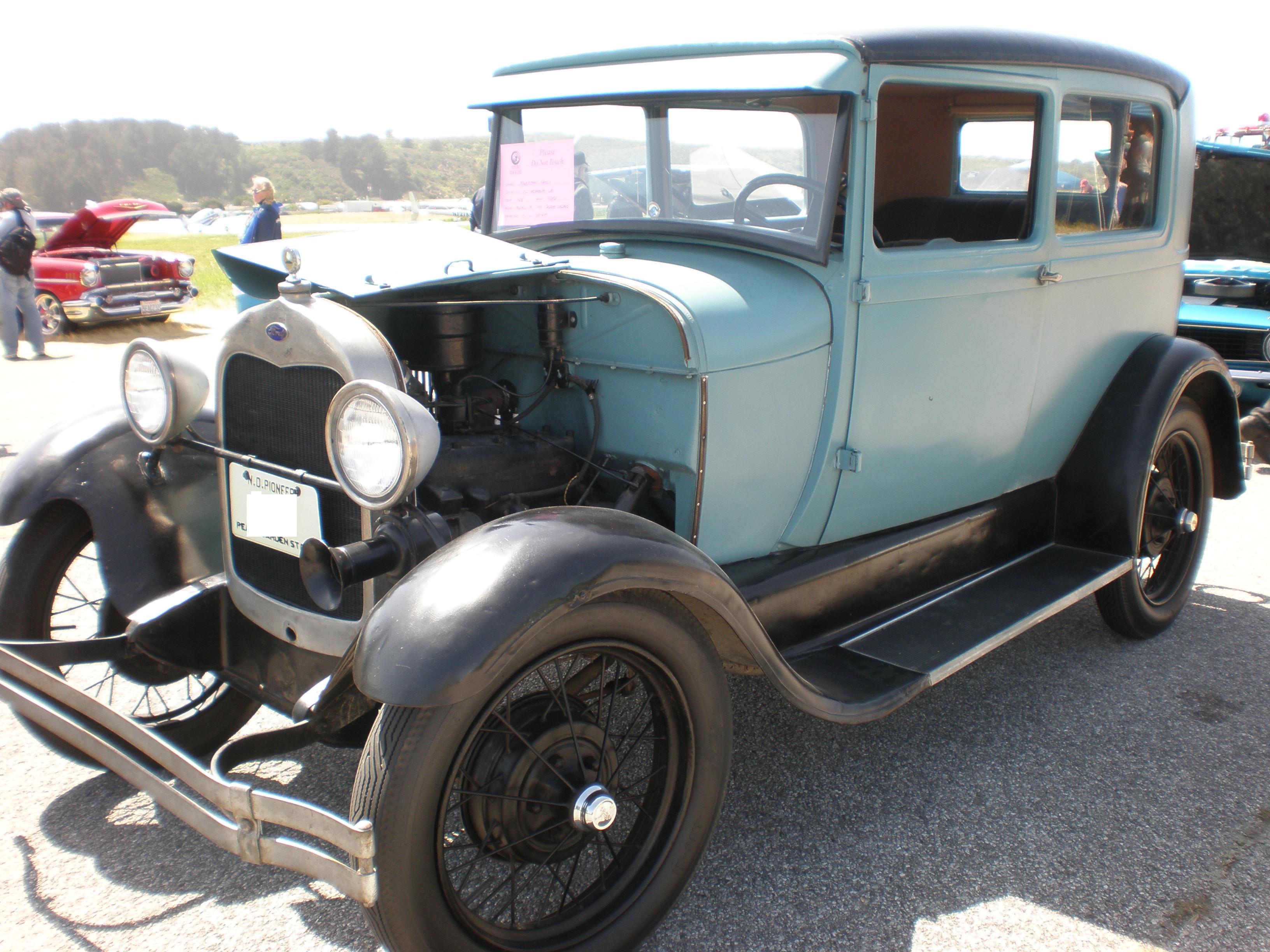
1920-1929 Ford model A

Ford model A/ A model Ford. Nicknamed A bone followed the footsteps of the model T

Origin: During the up-rise in the automotive industry; To follow up the success that Henry Ford had made through his Model T, he had taken it upon himself to make another better car. As a car of the Brass era, it was a huge deal that there was a car under development of such sort. The Brass era was the name of time period when the automotive industry started to rapidly rise, However, during the mid-1920s, this dominance eroded as competitors, notably General Motors, caught up with Ford's mass production system and began to outcompete Ford in some areas, especially by offering more powerful engines, new convenience features, or cosmetic customization.

Purpose Ford's sales force recognized the threat and advised Henry Ford to respond to it. Initially he resisted, but the T's sagging market share finally forced him to admit a replacement was needed. When he finally agreed to begin development of this new model, he focused on the mechanical aspects and on what today is called design for manufacturability (DFM), which he had always strongly embraced and for which the Model T production system was famous. SO basically meant to replace the ford model t

Value: Although ultimately successful, the development of the Model A included many problems that had to be resolved. For example, the die stamping of parts from sheet steel, which the Ford company had led to new heights of development with the Model T production system, was something Henry had always been ambivalent about; it had brought success, but he felt that it was not the best choice for durability. He was determined that the Model A would rely more on drop forgings than the Model T; but his ideas to improve the DFM of forging did not prove practical. Eventually, Ford's engineers persuaded him to relent, lest the Model A's production cost force up its retail price too much. It was during the period from the mid-1920s to early 1930s that the limits of the first generation of mass production, epitomized by the Model T production system, became apparent. The era of "flexible mass production" had begun. 

Limitations: World War One was behind everyone by now, even though there were still effects of it but it was the past, the car tell us how the cost of it went during the time  period compared to other vehicles